1School of Electrical & Electronic Engineering, Hanoi University of Science and Technology (HUST), Vietnam
*Corresponding author
Paper
Coming soon Code
Coming soon
Working draft. Not yet public and not yet submitted for peer
review — the paper and code will be posted here once ready.
No initial stabilizing policy needed$\hat\gamma$ within $\sim\!1\%$ of $\gamma^\star$, from data$30\%$ smaller disturbance gain than a data-driven LMI baselineSmall-gain certified for graphs with cycles
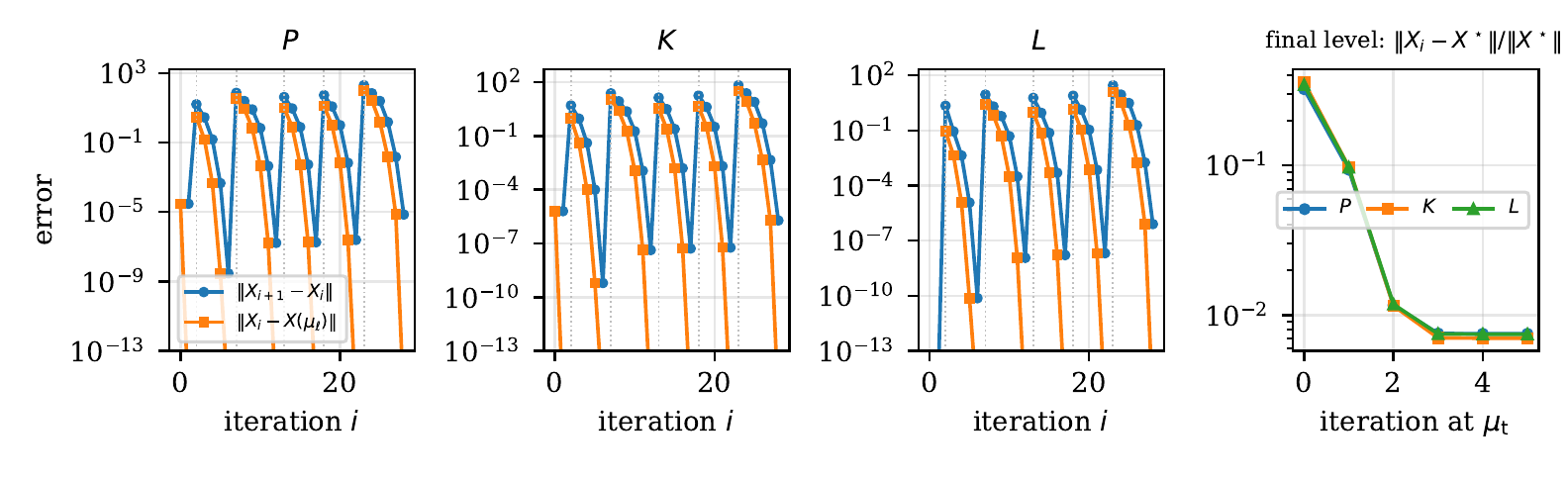
Player 1's whole learning run: six continuation levels in $\mu=\gamma^{-2}$, each converging
quadratically (blue: successive difference; orange: distance to that level's saddle point). Panel (d)
shows the final level closing in on the model-based optimum — using data only, with no initial
stabilizing gain and no system identification.
Overview
Nash equilibrium seeking, learned from data, robust to what you didn't model.
Distributed Nash equilibrium (NE) seeking for players with dynamics has recently been cast as a
cooperative output regulation problem, where the pseudo-gradient of the game plays the role of the
regulated error. We make this fully data-driven and add what that reformulation was missing: an
$H_\infty$-optimal attenuation of disturbances the model does not capture, a network-level guarantee
that survives communication graphs with cycles, and a plain account of what happens when the data
themselves are not exact.
Model-Free $H_\infty$ NE Seeking
Each player learns, from its own local input–state data, the saddle-point policy of a zero-sum
game on its internal-model-augmented dynamics — exact rejection of exosystem disturbances plus a
certified $\mathcal L_2$ attenuation of unmodelled ones, with no system identification, no initial
stabilizing gain, and no communication during learning.
Double-Homotopy Policy Iteration
A state-shift homotopy builds a stabilizing gain from scratch; a second continuation in
$\mu=\gamma^{-2}$ then carries the policy from the LQR solution to the $H_\infty$ solution, with every
iterate certified stabilizing directly from data. As a by-product, it returns a data-based estimate of
the optimal attenuation level $\gamma^\star$.
Beyond Acyclic Graphs
An explicit disturbance-to-pseudo-gradient $\mathcal L_2$ gain, automatic for acyclic graphs and
holding under a small-gain condition for graphs with cycles — both certified from each player's
own local data, with no model and no central computation.
An Honest Account of Inexact Data
An exact perturbation bound for the data solve, with an amplification factor computable from the same
data. The estimator is errors-in-variables biased, so collecting more data does not remove the
error — verified with $16\times$ more data. Averaging the learning identity over shifted
start times buys about a factor $30$ in tolerable noise.
Method
Two homotopies: one for stability, one for optimal attenuation.
Policy iteration is Newton's method on a Riccati equation and converges quadratically — but it must
start from a stabilizing policy, which is itself model information. For zero-sum games a second
difficulty appears: the simultaneous update is Newton's method on a Riccati equation with an
indefinite quadratic term, so a stabilizing pair alone is not enough for convergence. We remove
both obstacles with two nested homotopies, using only input–state data collected once, off-policy.
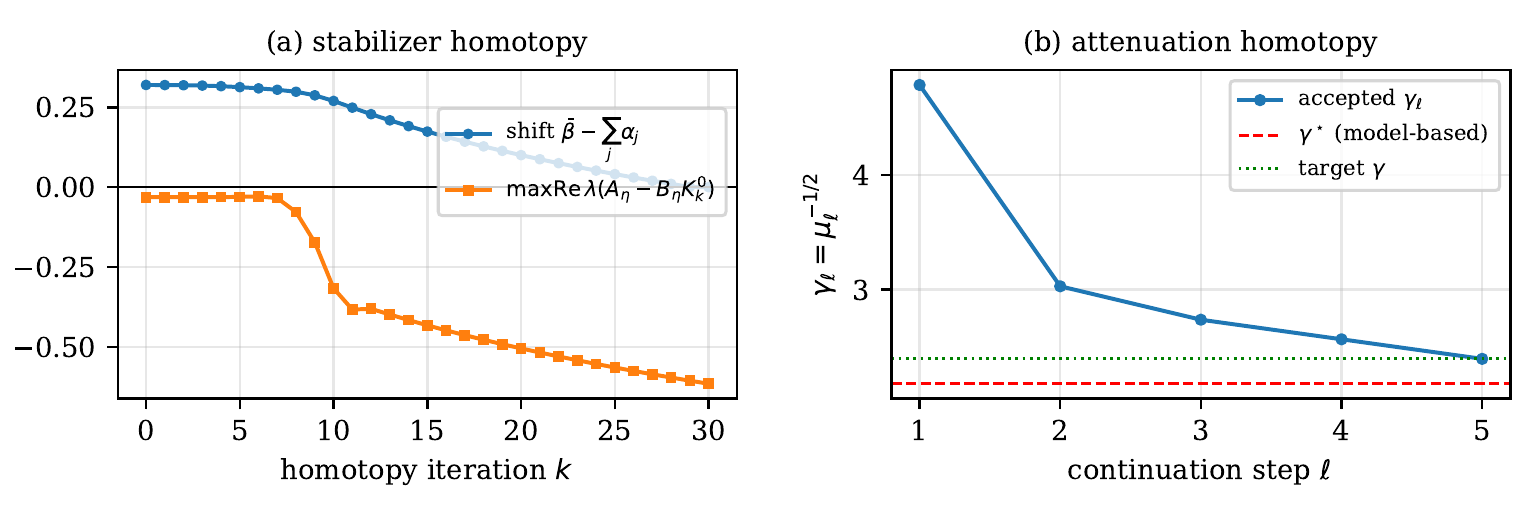
Double-homotopy policy iteration. (a) Phase I (state-shift homotopy): the shift
$\bar\beta-\sum\alpha$ is driven to zero while a data-based certified bound on the closed-loop spectral
abscissa holds, producing a stabilizing gain with no model. (b) Phase II (attenuation homotopy): a
continuation in $\mu=\gamma^{-2}$ carries the policy from $\gamma=\infty$ (the LQR solution) down to the
target level in a handful of accepted steps, each certified stabilizing from data before it is accepted.
Click to open full size.
Theorem (convergence of the attenuation homotopy)
Under a standard excitation condition on the collected data, the continuation in $\mu=\gamma^{-2}$
accepts only finitely many steps, every policy pair it uses is certified stabilizing, and the PI at the
target level converges quadratically to the true saddle point — for every
$\gamma>\gamma^\star$, with no initial stabilizing policy required. As a corollary, running the
continuation past the true optimum and taking the last accepted level gives a data-based estimate
$\hat\gamma\to\gamma^\star$.
A network-level counterpart holds too: if every player's learned gain is $\gamma_i>\gamma_i^\star$, the
closed-loop network is exponentially stable and $\|e\|_{\mathcal L_2}\le\Gamma\|d\|_{\mathcal L_2}$ for an
explicit $\Gamma$ — automatically on acyclic graphs, and under a small-gain condition, certified
from local data alone, on graphs with cycles.
Why the second homotopy is needed
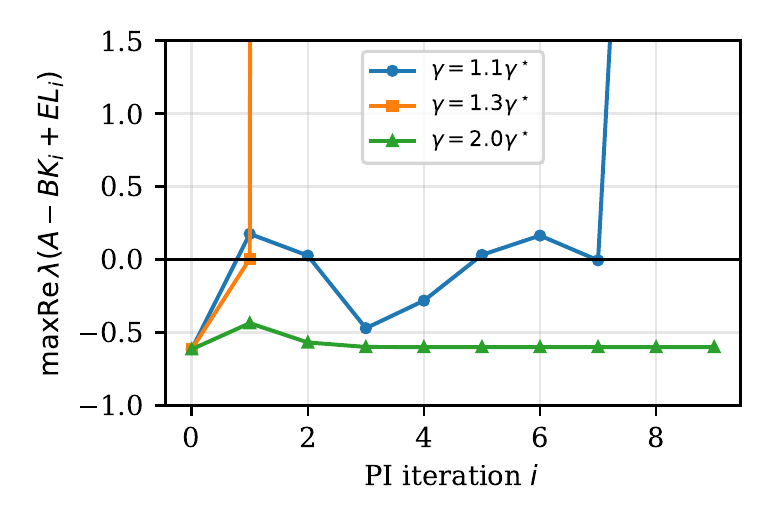
Simultaneous zero-sum policy iteration started from a genuinely stabilizing pair need not stay
stabilizing. On our benchmark, starting from the LQR gain at $\gamma=1.1\gamma^\star$ or $1.3\gamma^\star$
drives the closed loop unstable already at the first update, and the iteration diverges. This is a known
initialization difficulty for the game Riccati equation's indefinite quadratic term; the attenuation
homotopy sidesteps it by following the solution path in $\gamma$ instead of jumping straight to the
target level.
Started directly at the target level, without the continuation: for
$\gamma\le1.3\gamma^\star$ the iterates leave the stabilizing set within a few updates.
Results
Five heterogeneous robots, learned $H_\infty$ gains, and a fair fight with a robust baseline.
Five mobile robots with different friction coefficients play a network game on a communication graph,
each with an unknown linear model, an unmodelled $\mathcal L_2$ disturbance channel, and a known
exosystem to reject. Every player learns its gain from $600$ data intervals with no initial stabilizing
policy, and the resulting network is compared against the data-driven LMI design of Wang et al. (2026),
which stabilizes but is not optimal and needs an acyclic graph for its stability guarantee.
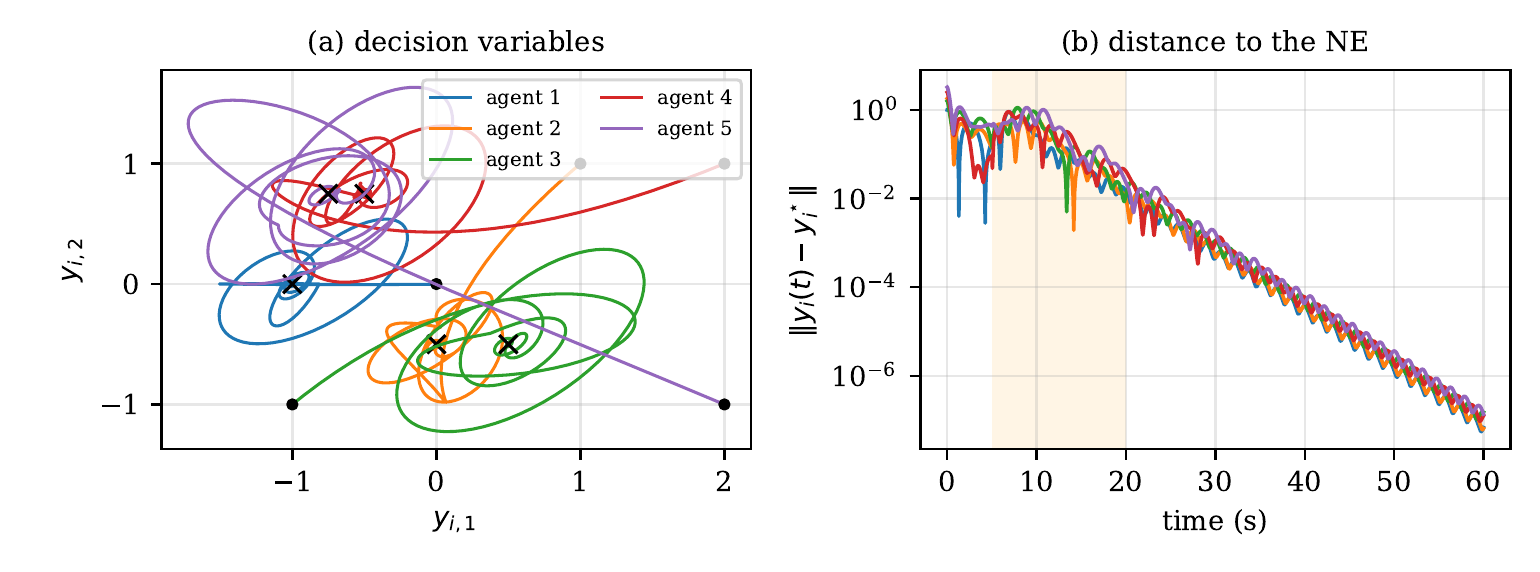
Decision variables under the learned controllers — phase plane (left) and distance to
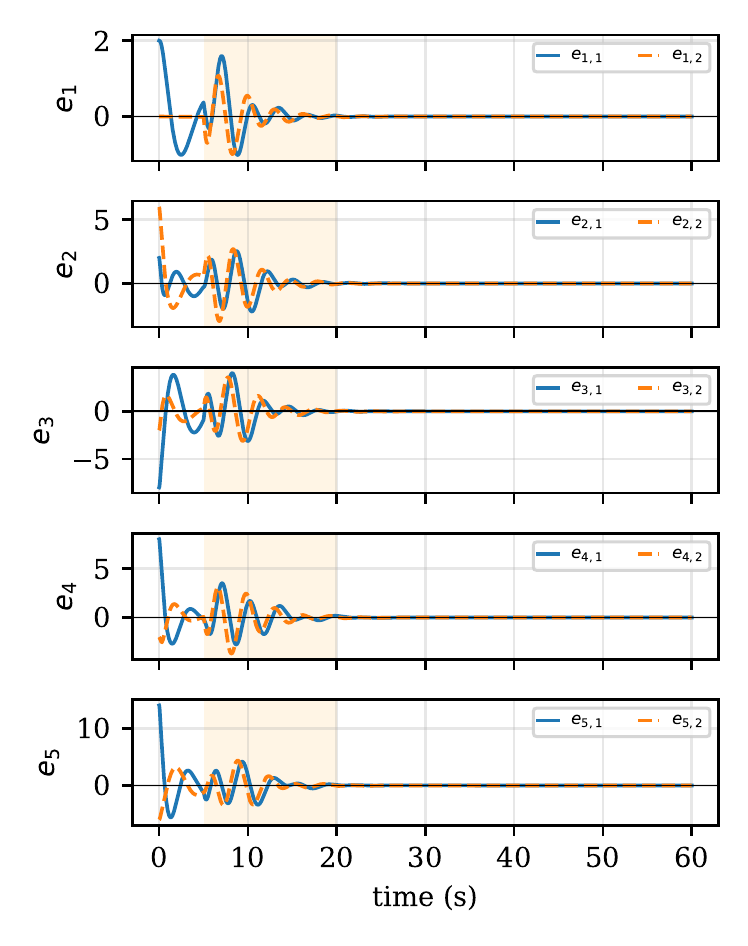
the NE over time (right); shaded, the $\mathcal L_2$ disturbance burst.Regulated error $e_i$ of every player: all ten components converge to zero although the
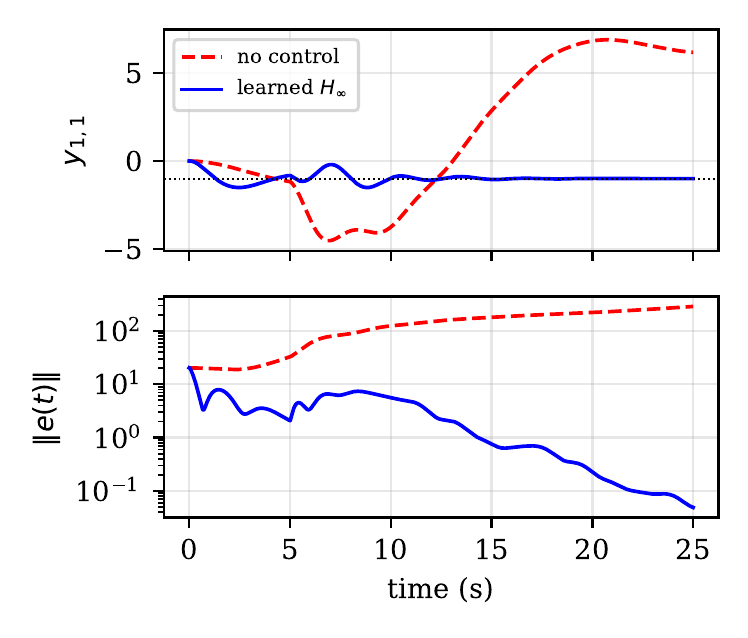
exosystem keeps acting and despite the $\mathcal L_2$ burst.With and without the learned controller: uncontrolled error peaks at $287$, controlled at
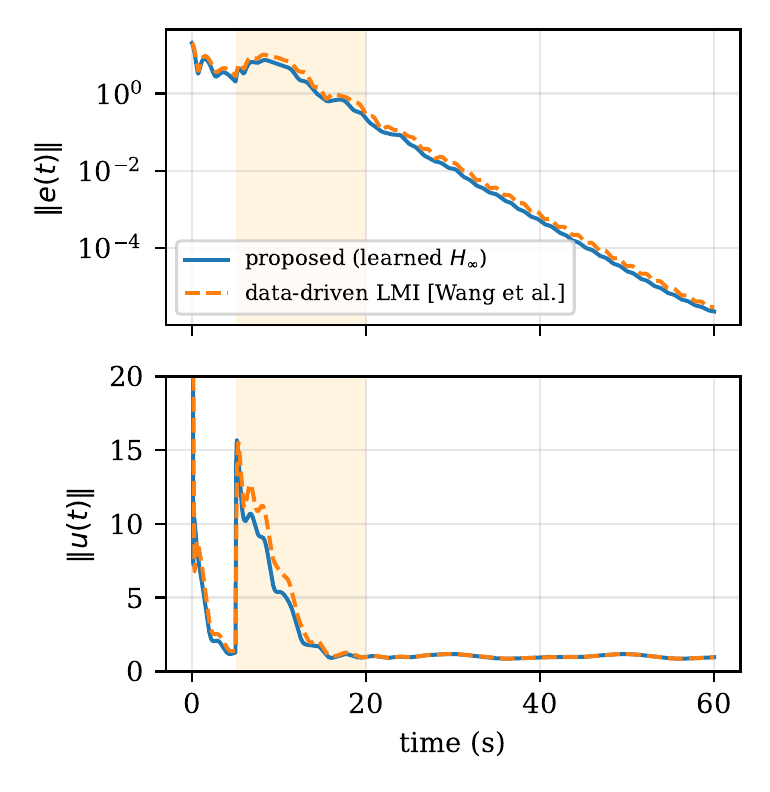
$20$.Pseudo-gradient norm and control effort versus the data-driven LMI baseline.Adding a cycle to the graph: the small-gain certificate is confirmed from data for coupling
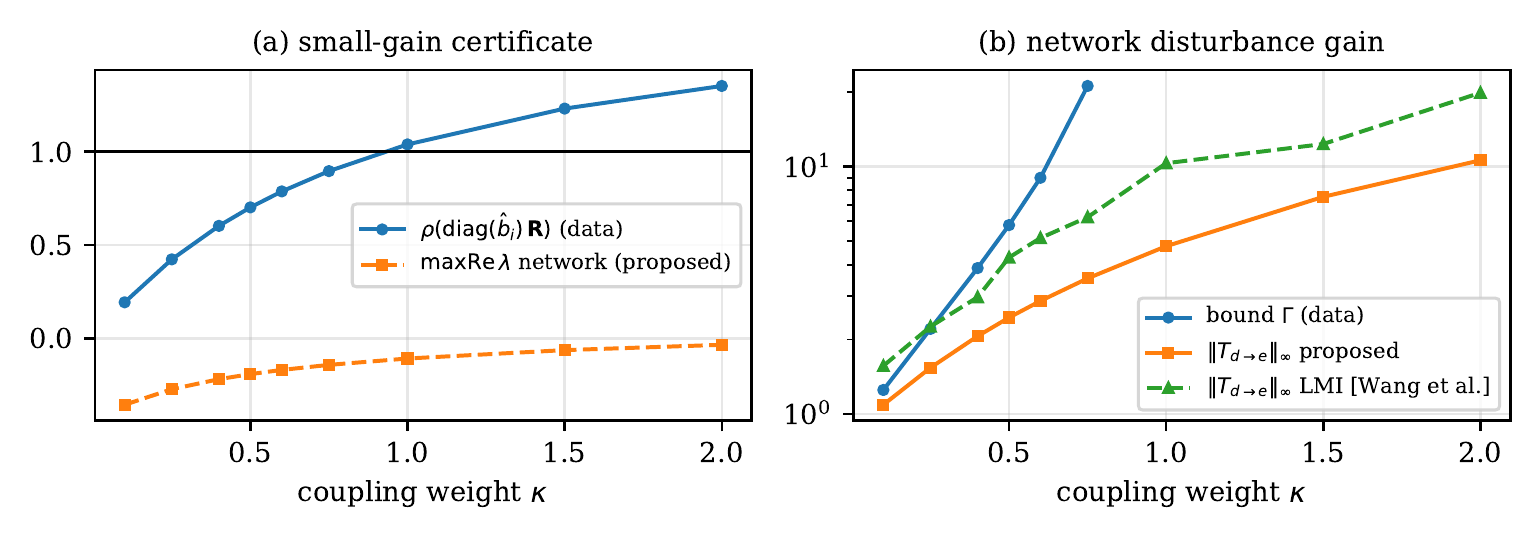
weights up to $0.75$; the learned gains keep a $1.4$–$2.2\times$ smaller disturbance gain than the
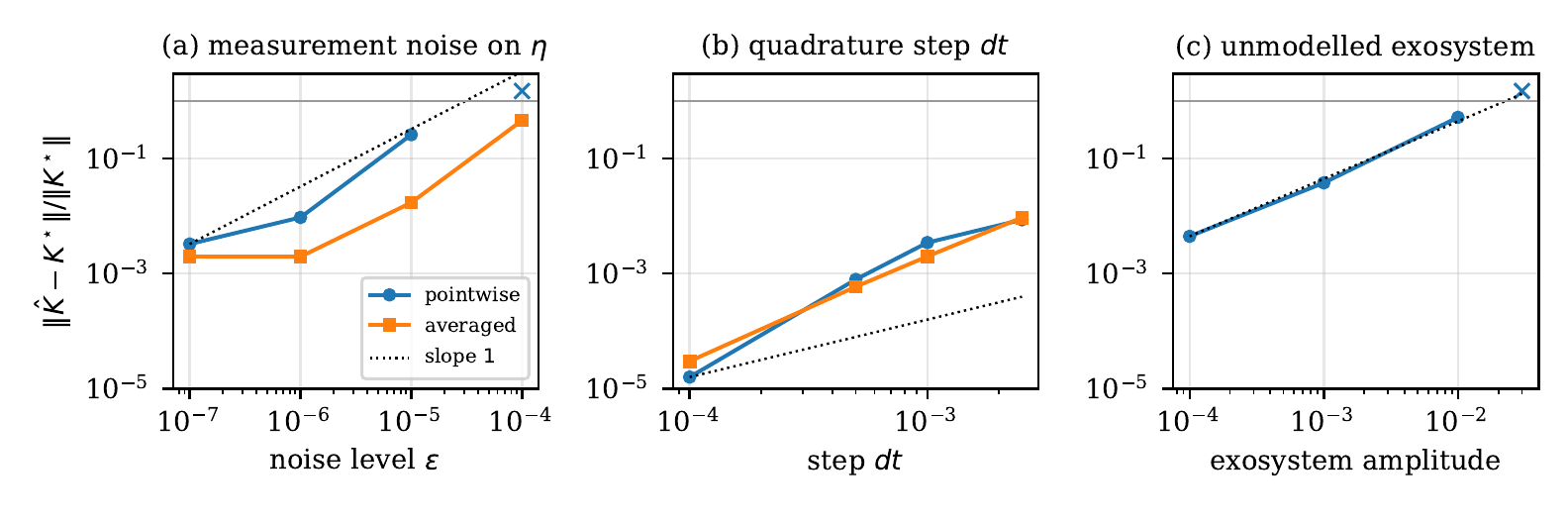
LMI baseline across the whole range, although the LMI's stability argument offers no guarantee here.Inexact data: gain error against measurement noise, quadrature step, and an unmodelled
exosystem. Averaging the learning identity over shifted start times (orange) buys about a factor $30$
in tolerable measurement noise over the naive functional (blue).
Learning results per player (model-based $\gamma^\star$, $K^\star$ shown only for validation — never
used by the algorithm):
Player
$\gamma^\star$
$\hat\gamma$ (data)
$\mu$-steps
PI iters
$\|K-K^\star\|/\|K^\star\|$
1
2.177
2.197
5
29
$9.5\times10^{-4}$
2
2.406
2.436
5
30
$2.7\times10^{-3}$
3
2.366
2.391
5
29
$1.7\times10^{-3}$
4
2.433
2.462
4
27
$2.9\times10^{-3}$
5
2.389
2.411
5
30
$3.3\times10^{-3}$
The data-based estimate $\hat\gamma$ is within about $1\%$ of the model-based $\gamma^\star$ for every
player, and the learned gain $K$ matches the true GARE solution $K^\star$ to $3\times10^{-3}$ relative
error — all without ever solving a model-based Riccati equation.
Network comparison with the data-driven LMI design (acyclic graph):
Proposed
LMI baseline
$\|T_{d\to e}\|_\infty$
3.62
5.15
$\|T_{d\to u}\|_\infty$
3.05
3.86
empirical $\|e\|_2/\|d\|_2$ (rest)
1.77
2.47
$\int_0^{60}\|e\|^2dt$
422
703
$\int_0^{60}\|u\|^2dt$
2080
1380
final $\|y-y^\star\|_\infty$
$1.3\times10^{-7}$
$2.0\times10^{-7}$
The learned $H_\infty$ gains give a $30\%$ smaller disturbance-to-error gain and a $30\%$ smaller
disturbance-to-input gain than the LMI baseline. The one line where the baseline wins is total control
energy over the full scenario — the learned gains are larger, which costs more effort during the
initial transient.
Citation
Cite this work
@misc{thai2026hinfne,
  title={Model-Free $H_\infty$ Nash Equilibrium Seeking in Network Games via
         Double-Homotopy Policy Iteration and Output Regulation},
  author={Thai, Khanh},
  year={2026},
  note={Working draft}
}